The Book "Poincare" – Discussed by Book Enthusiasts

The Book "Poincare" – Discussed by Book Enthusiasts

January 19 , 2024

|

215

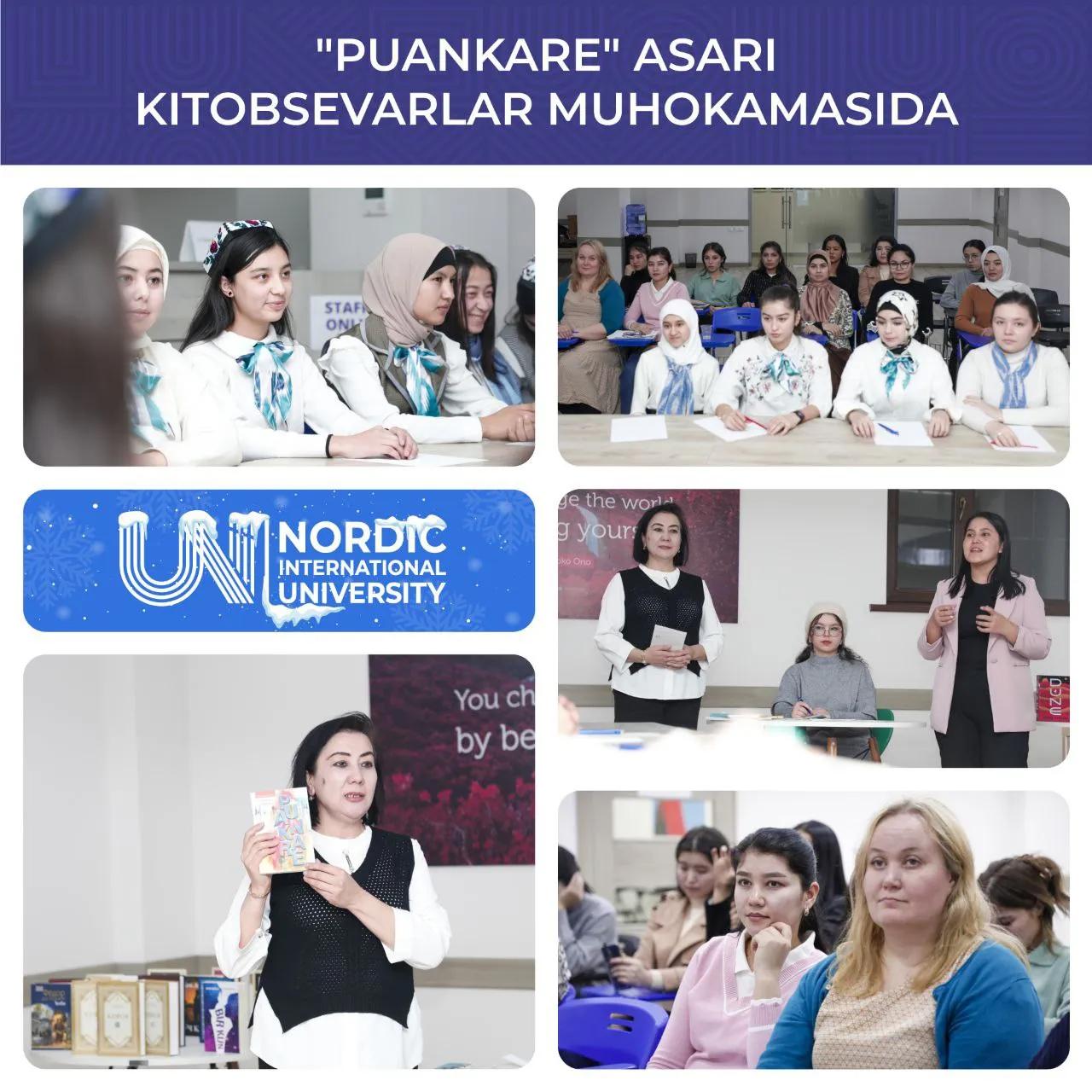
The book "Poincare" was actively discussed at the university.

This book can be called a symbol of conscience, as its protagonist overcomes obstacles on the path to a goal and conquers the peaks of humanity.

The book also proves that people pursuing science need someone who understands science, even in their personal life.

The book "Poincare" was read with great interest by the university community and students. It was widely discussed at an event involving book lovers, organized at the initiative of the University's Women's Council.

During the event, a display of new books received by the NIU Information Resource Center was also held.

Print

Latest news

Uzbekistan–Sweden Educational Dialogue: New Opportunities within a Global Scholarship Program

Uzbekistan–Sweden Educational Dialogue: New Opportunities within a Global Scholarship Program

This meeting became another important initiative aimed at connecting young people of Uzbekistan with prestigious educational and professional development opportunities in Europe.


Along with representatives of the Embassy, the dialogue was attended by representatives of the Ministry of Higher Education, Science and Innovations of the Republic of Uzbekistan, the “El-yurt umidi” Foundation, Nordic International University, and the University of World Economy and Diplomacy.


As a result of the Embassy’s efforts, Uzbekistan was included in the GPS program list covering 34 countries. This program opens significant opportunities, particularly for talented young people completing their undergraduate studies, to pursue education and gain professional experience in Sweden.


During the dialogue, the leadership of Nordic International University delivered a presentation on the university’s activities and international academic initiatives. In addition, in order to further expand cooperation, a proposal was made to launch Swedish language courses, alongside Finnish, at Nordic International University. This initiative is intended to strengthen educational integration and enhance cultural exchange.


At the conclusion of the discussions, Nordic International University was recognized as playing an important role as an “intensive hub” in the development of academic, scientific, and cultural cooperation between Uzbekistan and the countries of Northern Europe.

Gifts Caravan from Nordic International School

Gifts Caravan from Nordic International School

The traditional charity event, initiated by the teachers of Nordic International School and the parents of its students, was filled with care, kindness, and sincere compassion.


The children’s pure and heartfelt letters to Santa Claus did not go unanswered — every single wish came true.


 New Year gifts, warm wishes and congratulations, songs and music, cheerful moments, and most importantly, genuine love and care brought light to the children’s hearts and smiles to their faces.

Digital Transformation and Artificial Intelligence in Higher Education: A Step Toward University 4.0 and 5.0

Digital Transformation and Artificial Intelligence in Higher Education: A Step Toward University 4.0 and 5.0

At the seminar, Alisher Abdullayev, Director of the Center for the Development of Digital Education Technologies under the Ministry of Higher Education, Science and Innovation of the Republic of Uzbekistan, shared new knowledge and practical experience with faculty members on global trends, applied solutions, and strategic approaches that are fundamentally transforming higher education.


Quote:

“Artificial intelligence learns, analyzes, makes decisions, and develops itself like a human. Today it is an assistant; tomorrow it will become a strategic partner in education.

 • Universities are no longer factories, but centers of innovation.

 • Future universities are based on the principle of knowledge + personalization, individualization + global integration.

 • Individual work with each student is now becoming a real opportunity.

 • Modern university laboratories must have GPU servers, because artificial intelligence cannot develop without infrastructure.

 • AI can assist in writing articles, but it cannot replace the researcher.

 • Universities should no longer chase technology, but become centers that create and manage it.”


During the seminar, modern university models were analyzed in depth, and the importance of moving toward the concepts of University 4.0 and 5.0 was emphasized.


Through AI technologies:

 • students’ knowledge levels are analyzed

 • learning trajectories are personalized

 • efficient use of time and resources is ensured


Artificial intelligence is creating new opportunities for students, teachers, and universities.


The speaker paid special attention to the practical application of AI in educational processes, including:

 • analysis and assessment of essays,

 • automatic generation of tests and assignments,

 • in-depth analysis of GPA and academic activity,

 • monitoring examinations through AI proctoring.


Scientific research and AI mean both opportunity and responsibility. The seminar thoroughly analyzed not only the possibilities of using AI in scientific activity, but also the risks:

 • incorrect conclusions

 • misinterpretation of context

 • errors related to citations and authorship

 • decline in the quality of original research


Issues such as the DOI system, adherence to academic ethics, and avoiding predatory journals were also highlighted as pressing scientific concerns.


Today, administrative, academic, and financial processes in higher education are fully digitized:

207 higher education institutions, 1.7 million students, 45,000 faculty members, 30 key information systems, and 40 electronic services have been integrated into a single platform.


Through HEMIS AI, students receive individualized academic and career recommendations; AI mock interviews are conducted; resumes and vacancies are matched; and graduate employment is monitored.


The seminar once again emphasized that artificial intelligence in higher education is not the future, but a tool of today. The main task is to use technology wisely, responsibly, and in accordance with scientific ethics.


At the end of the seminar, faculty members’ suggestions and feedback were heard, and their questions were answered.

Quality, Results, and New Milestones: NORDIC University’s 2025 Outcomes Reviewed

Quality, Results, and New Milestones: NORDIC University’s 2025 Outcomes Reviewed

During the meeting, a comprehensive review was conducted of the academic and non-academic activities implemented within the framework of 2025, declared as the “Year of Advancing Educational Quality and Strengthening Scientific Research.”


Throughout the year, the university’s consistent steps toward sustainable development across all its structures were highly recognized, along with its systematic approaches to improving education quality and enhancing scientific potential. In particular, the geography of international cooperation expanded and was further strengthened through new negotiations, visits, memorandums, and scholarly exchanges. The scope of scientific research, publications, grants, and projects broadened, and a distinctive Nordic experience in the field of education export was formed.


In addition, digital development and effective governance mechanisms, the system of spiritual and educational activities, achievements of faculty and students, scientific successes, and the activities of newly established centers were analyzed. It was emphasized that these processes contribute significantly to reinforcing education quality with positive outcomes.


At the meeting, the Rector outlined the key priorities, strategic directions, and clear objectives for the team within the framework of 2026 — “Towards a Green University: Training Competitive Professionals Based on Global Labor Market Demand.”


These directions aim to elevate education quality to a new level, develop scientific research in line with international standards, and strengthen the university’s global competitiveness.


In particular, introducing AI-integrated approaches into the educational process and further improving academic programs based on labor market demands were identified as priority tasks.


Measures were also set to expand academic mobility opportunities for faculty and students, ensure thorough preparation for international and national accreditations, and develop faculties based on industry cluster models.


Furthermore, the introduction of KPI and ranking systems for education quality, systematic support for student employment and startup initiatives, increasing the share of practice-oriented subjects, and improving course design and assessment systems were highlighted as important tasks.


In addition, ensuring consistency in targeted efforts within admissions and marketing processes and actively promoting Nordic’s scientific outputs in international academic databases were defined as key objectives. Through these approaches, the consistent development of a digital, open, and human-centered university model is envisaged.


Important information was also shared regarding international professional development opportunities for faculty members, new academic programs, and the upcoming training week.


At this meeting, the team of Nordic International University was encouraged to move forward more proactively based on a clear strategy, well-structured plans, and collective responsibility.

Follow the official channel on Telegram

Subscribe to our YouTube channel

Follow our page on Facebook

Connect with our LinkedIn profile