Who is at the center of decision-making in the digital age?

Who is at the center of decision-making in the digital age?

February 04 , 2026

|

664

Today, artificial intelligence, digital systems, and smart algorithms are increasingly becoming an integral part of our lives. However, an important question remains: Is artificial intelligence in control, or is it the human being?

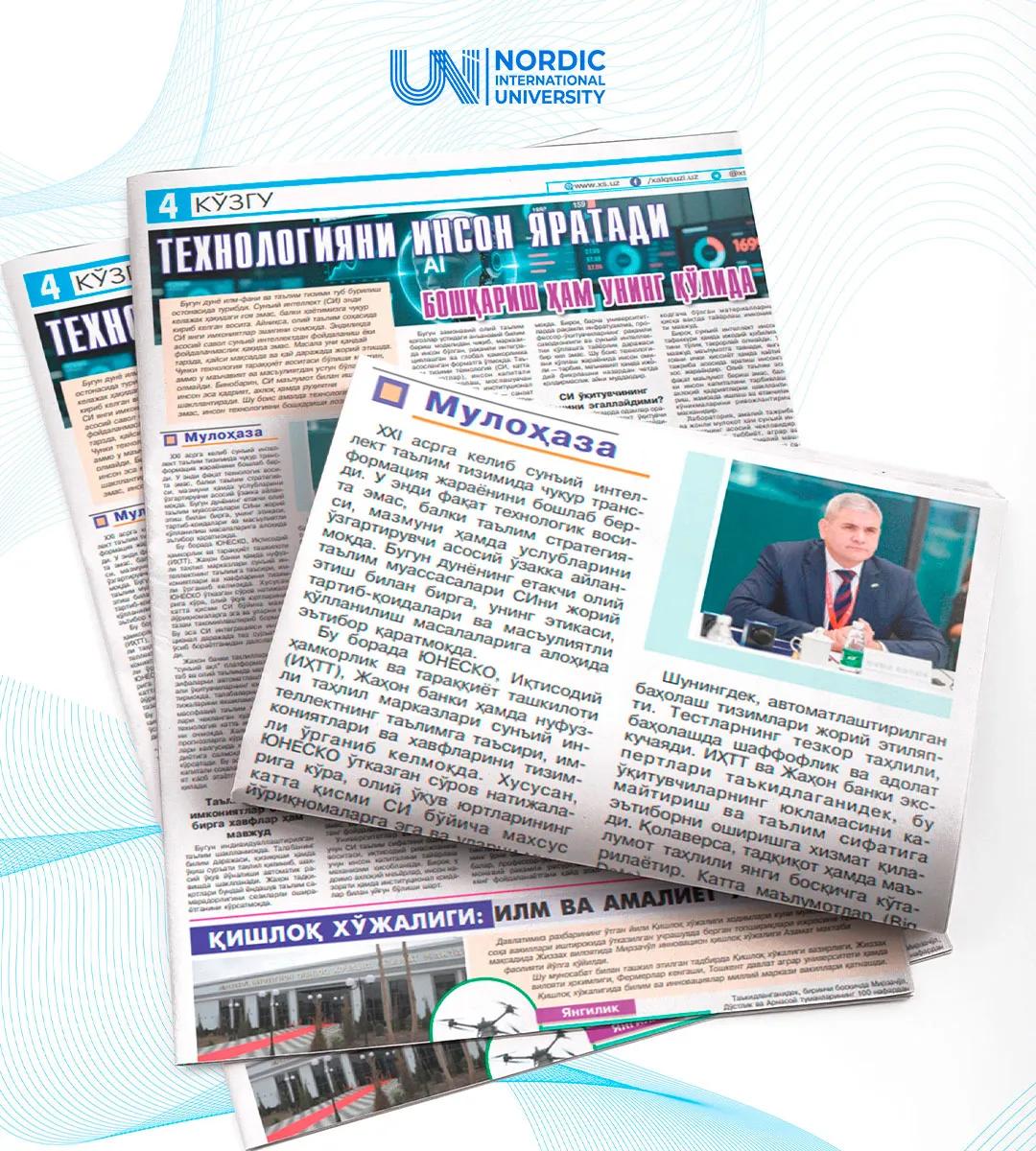
The latest issue of the “Xalq so‘zi” newspaper presents in-depth analysis around this very topic. In an article authored by Nordic Vice-Rector Muhammadsidiq Amonboyev, the human factor, responsibility in decision-making, and ethical considerations are thoroughly examined against the backdrop of rapid technological development.


The article discusses the impact of AI and digital technologies on society and all sectors, including the higher education system, highlights the role of human thinking in governance, and emphasizes directing technology toward meaningful and purposeful goals. It is not only about technology—it also offers reflections on who will shape the future and how it will be governed.


You can read the full analytical article in the February 4 issue of “Xalq so‘zi.”

Print

Latest news

Nordik’s New Academic Publications Officially Approved for Release

Nordik’s New Academic Publications Officially Approved for Release

📘 “World History: The Ancient Period and the First States”

Authors: Mukhriddin Pardayev, Najmiddin Qodirov.


This textbook establishes a solid academic foundation for students and history enthusiasts, offering comprehensive insights into the emergence of early civilizations and the formation of the first states.


📗 “Economic Development”

Authors: Ra’no Mardonova, Javlonbek O‘razaliyev, Mashhurbek Maqsudov, Madina Shakirova.


The textbook addresses global economic dynamics, sustainable growth, and contemporary reforms, enhancing awareness and fostering analytical thinking in alignment with modern educational standards.


💻 “Digital Technologies”

Author: Muzaffarjon Abdulaxatov.


This publication explores the digital landscape, artificial intelligence, and advanced IT solutions. Designed as a practical and innovative guide, it equips learners with the competencies required for future-oriented professions.


📖 Broaden your academic horizons with Nordik publications.

Towards a Holistically Developed Individual: A Motivational Meeting for Future Educators

Towards a Holistically Developed Individual: A Motivational Meeting for Future Educators

The session, entitled “A Well-Rounded Individual, a Skilled Professional, and a Distinct Personality,” evolved into a dynamic academic and motivational platform for professional engagement.


The training was conducted by Professor Odil Qo‘ysinov, Vice-Rector for Research and Innovation, and Professor Sherali Abduraimov of the Department of Pedagogical Education and Psychology. The speakers provided participants with a comprehensive and analytical insight into the contemporary philosophy of education and the ongoing educational reforms.


Conducted in an open dialogue format, the session addressed the practical outcomes of educational reforms, approaches grounded in Finnish experience and international standards, and solutions developed through real-life case studies. In addition, detailed information was presented on the university’s modern educational services, innovative models of teacher training and professional development, joint international programs, and internship opportunities.


Students of the Primary Education program and practicing specialists actively participated in the master class, receiving valuable recommendations on effectively integrating theory with practice.

Another International Achievement for Nordic — Scopus Q1: Faculty Publications in the Highest Scientific Tier

Another International Achievement for Nordic — Scopus Q1: Faculty Publications in the Highest Scientific Tier

Publication in a Scopus Q1 journal confirms that the research has successfully undergone rigorous international peer review and demonstrates scientific novelty and methodological robustness.


🔬 Article 1

“Bio-Integrated Wearable Systems for Continuous Medical Monitoring Based on Materials, Device Architectures, and Clinical Applications”


This study provides a comprehensive analysis of bio-integrated wearable systems enabling real-time health monitoring.

Continuous tracking of:

heart rate,

blood pressure,

glucose levels,

oxygen saturation

is no longer a futuristic concept, but a present-day technological reality.

The article scientifically examines advanced biomaterials, device architectures, and their clinical applications.


🔗 Full article: https://nesciences.com/article/72994/

🔬 Article 2

“Micro - and Nanoengineered Biosensing Platforms for Translational Medicine Enabling Ultrasensitive Detection and Bedside Decision Support”

This research explores biosensing platforms based on micro- and nanoengineering technologies.

The Point-of-Care approach enables rapid diagnostics directly at the patient’s bedside, beyond conventional laboratory settings.

High sensitivity and precision represent critical requirements of modern medicine. The study presents not only scientific innovation but also an applied solution with strong potential for clinical implementation.


🔗 Full article: https://nesciences.com/article/72983/

O‘zbekiston 24 | Carnegie R1-Level Partnership: Building a Scientific Bridge from Tashkent to Washington

O‘zbekiston 24 | Carnegie R1-Level Partnership: Building a Scientific Bridge from Tashkent to Washington

According to Dr. Lowman, the strategic partnership established with Xalqaro Nordik universiteti represents a practice-oriented academic initiative aimed at producing measurable scientific and educational outcomes.


Within the framework of the Nordic — Rowan (https://www.rowan.edu/) collaboration, the newly established international center provides students with opportunities to:

➖pursue dual-degree programs and obtain diplomas from both institutions;

➖begin their studies in Tashkent and subsequently integrate into the U.S. academic environment;

➖engage in joint research initiatives and academic mobility programs, including exchanges of faculty members, researchers, and students, thereby acquiring global academic exposure.


“Any initiative that brings countries and peoples together through cooperation yields creative and constructive outcomes,” emphasized Dr. Lowman.

This visit signifies not merely diplomatic engagement, but a milestone in scientific integration, innovation-driven collaboration, and the expansion of global opportunities for youth."


Interest in the program is expected to increase significantly during the upcoming fall semester, indicating that Uzbek–American academic cooperation is entering a new and advanced stage of development.

Follow the official channel on Telegram

Subscribe to our YouTube channel

Follow our page on Facebook

Connect with our LinkedIn profile