Balancing Mental Effort with Physical Activity!

April 29 , 2023
98
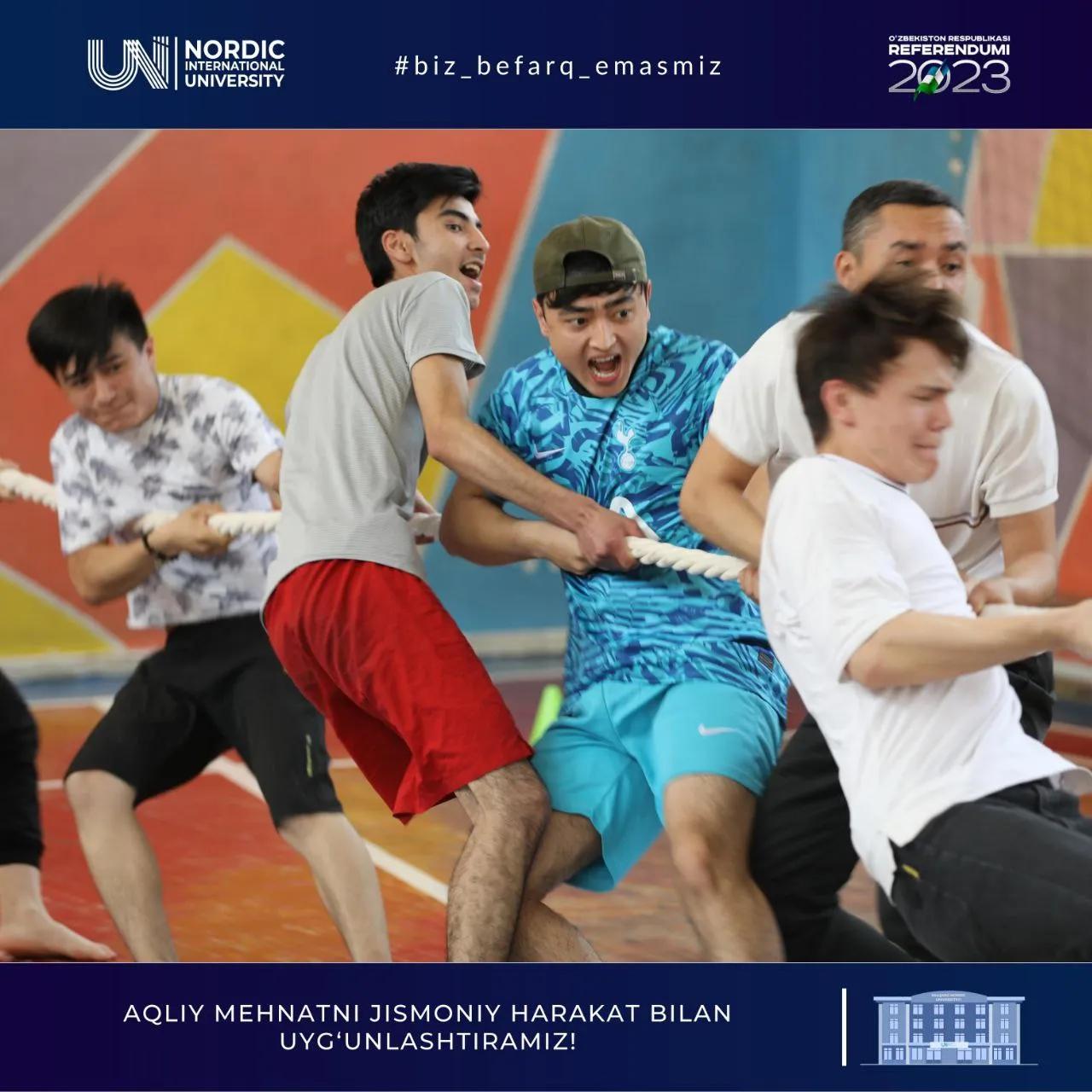
NIU and Ibn Sina Technical School organized relay races and sports competitions dedicated to "Referendum-2023".
📌 Today, knowledge-driven students of the Nordic International University are engaging in relay competitions to enhance their physical activity.
🔹 In collaboration with the Abu Ali Ibn Sina Public Health Technical School, the competitions include:
✔️ Relay races
✔️ Tug-of-war competitions
✔️ Sports activities promoting physical fitness
📌 The events are dedicated to "Referendum-2023" and are held at polling station No. 292 over two days.
📢 A healthy mind in a healthy body – the key to success!
Latest news

The 12th Meeting of the NIU Council: Review of 2025 and Prospects for 2026
First, reports were presented by responsible officials on the agenda item “Review of scientific research activities carried out at the university in 2025 and approval of the 2026 plan.” The effectiveness of research activities, the quality of publications and studies, and the results achieved in priority scientific areas were analyzed. Goals and performance indicators for 2026 were defined.
The Council also reviewed and approved a number of important documents regulating the educational process, including regulations, a Roadmap, and guidelines.
In particular, the newly adopted guidelines on the use of artificial intelligence established procedures for the responsible, transparent, and effective use of modern technologies in education and scientific research.
During the meeting, several other issues were considered, such as the submission of documents for obtaining the academic title of professor; the results of surveys conducted among students and staff (including a problem bank, proposals, and conclusions); and recommendations for publishing educational materials developed by faculty members.
As a result of the meeting, important decisions were adopted aimed at strengthening the integration of scientific governance, academic quality, and innovative approaches at the university. Tasks were set for 2026 to increase the effectiveness of research activities and to elevate the quality of education to a new level.
At the meeting, faculty members who achieved notable scientific accomplishments and received recognition during the year were warmly honored and congratulated on their successes.

Uzbekistan–Sweden Educational Dialogue: New Opportunities within a Global Scholarship Program
This meeting became another important initiative aimed at connecting young people of Uzbekistan with prestigious educational and professional development opportunities in Europe.
Along with representatives of the Embassy, the dialogue was attended by representatives of the Ministry of Higher Education, Science and Innovations of the Republic of Uzbekistan, the “El-yurt umidi” Foundation, Nordic International University, and the University of World Economy and Diplomacy.
As a result of the Embassy’s efforts, Uzbekistan was included in the GPS program list covering 34 countries. This program opens significant opportunities, particularly for talented young people completing their undergraduate studies, to pursue education and gain professional experience in Sweden.
During the dialogue, the leadership of Nordic International University delivered a presentation on the university’s activities and international academic initiatives. In addition, in order to further expand cooperation, a proposal was made to launch Swedish language courses, alongside Finnish, at Nordic International University. This initiative is intended to strengthen educational integration and enhance cultural exchange.
At the conclusion of the discussions, Nordic International University was recognized as playing an important role as an “intensive hub” in the development of academic, scientific, and cultural cooperation between Uzbekistan and the countries of Northern Europe.

Gifts Caravan from Nordic International School
The traditional charity event, initiated by the teachers of Nordic International School and the parents of its students, was filled with care, kindness, and sincere compassion.
The children’s pure and heartfelt letters to Santa Claus did not go unanswered — every single wish came true.
New Year gifts, warm wishes and congratulations, songs and music, cheerful moments, and most importantly, genuine love and care brought light to the children’s hearts and smiles to their faces.

Digital Transformation and Artificial Intelligence in Higher Education: A Step Toward University 4.0 and 5.0
At the seminar, Alisher Abdullayev, Director of the Center for the Development of Digital Education Technologies under the Ministry of Higher Education, Science and Innovation of the Republic of Uzbekistan, shared new knowledge and practical experience with faculty members on global trends, applied solutions, and strategic approaches that are fundamentally transforming higher education.
Quote:
“Artificial intelligence learns, analyzes, makes decisions, and develops itself like a human. Today it is an assistant; tomorrow it will become a strategic partner in education.
• Universities are no longer factories, but centers of innovation.
• Future universities are based on the principle of knowledge + personalization, individualization + global integration.
• Individual work with each student is now becoming a real opportunity.
• Modern university laboratories must have GPU servers, because artificial intelligence cannot develop without infrastructure.
• AI can assist in writing articles, but it cannot replace the researcher.
• Universities should no longer chase technology, but become centers that create and manage it.”
During the seminar, modern university models were analyzed in depth, and the importance of moving toward the concepts of University 4.0 and 5.0 was emphasized.
Through AI technologies:
• students’ knowledge levels are analyzed
• learning trajectories are personalized
• efficient use of time and resources is ensured
Artificial intelligence is creating new opportunities for students, teachers, and universities.
The speaker paid special attention to the practical application of AI in educational processes, including:
• analysis and assessment of essays,
• automatic generation of tests and assignments,
• in-depth analysis of GPA and academic activity,
• monitoring examinations through AI proctoring.
Scientific research and AI mean both opportunity and responsibility. The seminar thoroughly analyzed not only the possibilities of using AI in scientific activity, but also the risks:
• incorrect conclusions
• misinterpretation of context
• errors related to citations and authorship
• decline in the quality of original research
Issues such as the DOI system, adherence to academic ethics, and avoiding predatory journals were also highlighted as pressing scientific concerns.
Today, administrative, academic, and financial processes in higher education are fully digitized:
207 higher education institutions, 1.7 million students, 45,000 faculty members, 30 key information systems, and 40 electronic services have been integrated into a single platform.
Through HEMIS AI, students receive individualized academic and career recommendations; AI mock interviews are conducted; resumes and vacancies are matched; and graduate employment is monitored.
The seminar once again emphasized that artificial intelligence in higher education is not the future, but a tool of today. The main task is to use technology wisely, responsibly, and in accordance with scientific ethics.
At the end of the seminar, faculty members’ suggestions and feedback were heard, and their questions were answered.
