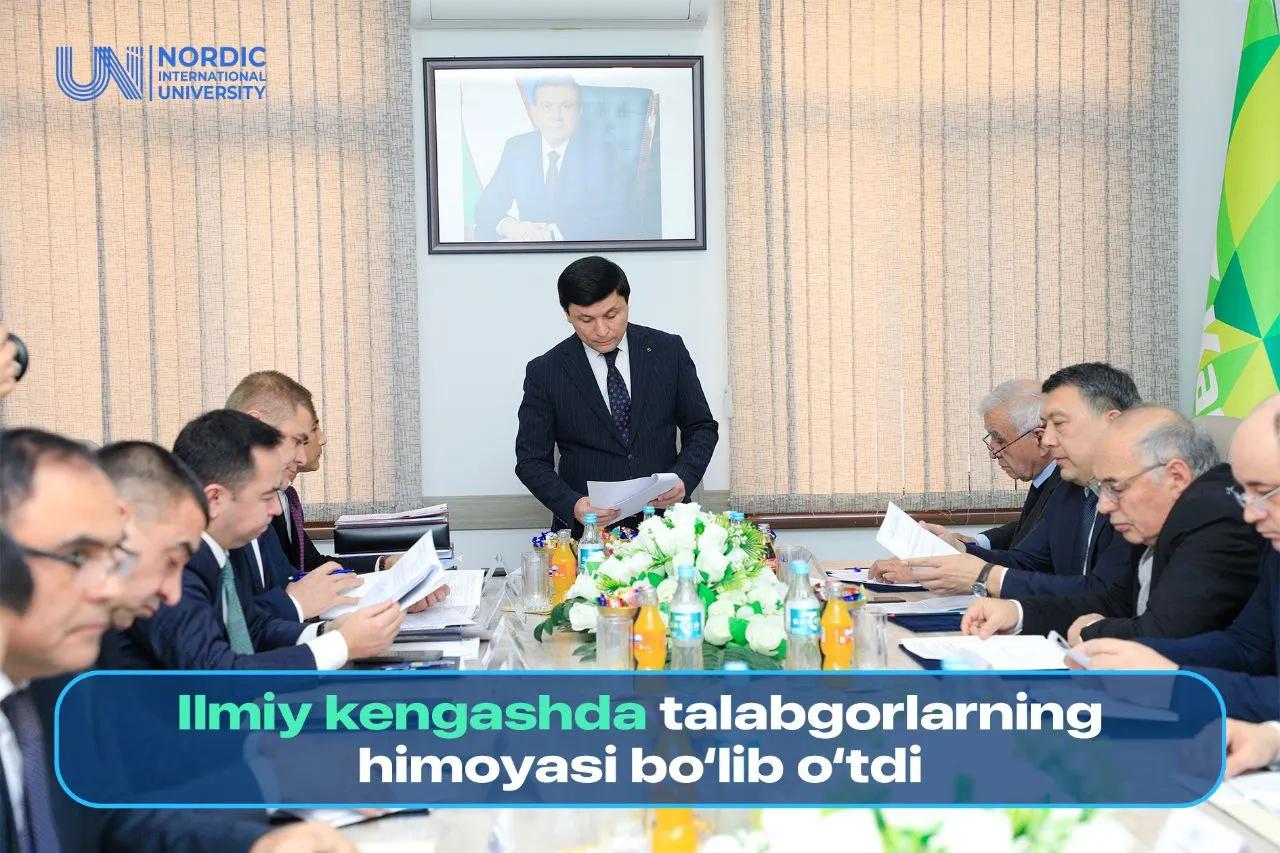
The following defenses were successfully advocated in the Council of XNU

January 15 , 2025
1015
Scientific life
The next defense work was done at the Scientific Council of the Nordic University numbered PhD.03/29.12.2022.I.157.01.
Yoldoshev Jahongir Toraboyevich, an independent researcher of the Tashkent State University of Economics, gave a detailed introduction to the essence of the theoretical and practical defense work on the topic "Improving the practice of financing higher education institutions in the Republic of Uzbekistan".
Also, the defense work of the independent researcher of Namangan State University Isakov Zafarjon Zakirjonovich on the topic "Directions for improving the mechanism of collecting local taxes and fees in the formation of local budget revenues" was widely discussed.
Both candidates successfully defended their dissertations for the PhD degree.
Latest news

Textbooks by Nordic faculty officially approved for publication!
Approved textbooks:
🔹 “Database Management Systems 1”
Authors: Istorakhon Abdusalomova, Doniyorbek Usmanbayev, Fotima Sofoyeva
🔹 “Methodology of Educational Work”
Author: Fotima Islamova
🔹 “Methods of Teaching Music”
Author: Dilnozakhon Sabirdjanova
🔹 “Fundamentals of Psychological Training”
Author: Mansur Kholmatov
🔹 “Ethnopedagogy in Preschool Education”
Author: Marguba Khasanova
💡 These textbooks integrate theoretical knowledge with practical application, meeting the requirements of modern education and serving as effective and student-friendly methodological resources.
🚀 This achievement represents yet another significant contribution to the academic excellence and educational quality of our university.

Parade of Nations: Cultural Values Through the Eyes of Students
Each team represented a different country, embodying its traditions and identity. Every performance reflected the historical essence of a nation, while the culinary exhibitions showcased the richness and diversity of national cuisines.
The gastronomic traditions of countries such as the United States, France, Finland, Türkiye, Korea, Italy, and many others were presented and thoughtfully interpreted.
Live music performances and student renditions of traditional and contemporary songs added a vibrant spirit to the celebration. Through their creativity and dedication, students demonstrated not only their talents but also their broad мировiew and intellectual curiosity.
Winners were recognized across multiple categories, including best table presentation, costume, stage concept, decoration, and taste. Each team’s effort, creativity, and strong sense of collaboration were duly acknowledged and appreciated.
The “Parade of Nations” became a symbolic microcosm of the world itself — a space without cultural boundaries or language barriers, where creativity, mutual respect, and shared curiosity brought everyone together in harmony.

National Identity: A Three-Thousand-Year Memory and Contemporary Consciousness
Authored by Professor Yulduz Ortiqova, Doctor of Philological Sciences, from the Department of Social Sciences and Journalism, the textbook “National Identity and Mass Media” provides a scholarly exploration of one of the most nuanced and pressing issues in modern journalism: understanding national identity and accurately representing it within the information space.
The presentation was attended by Salim Doniyorov, Editor-in-Chief of the “Yangi O‘zbekiston” newspaper, Doctor of Philological Sciences, and Professor Fayzulla Mo‘minov of the Uzbekistan State University of Journalism and Mass Communications. The distinguished guests offered in-depth reflections on the academic, cultural, and practical significance of the work. For students, the event became not only an introduction to a new textbook but also an opportunity to engage with profound life experiences and intellectual perspectives.
During the session, keynote speakers—Professor Fayzulla Mo‘minov and Najmiddin Qodirov — emphasized the historical formation of national identity, noting that it has not emerged effortlessly but through trials, losses, and resilience. They highlighted that national identity represents a complex and vital concept intertwined with a nation’s three-thousand-year historical memory, dignity, and future.
Approaching the topic from a broader socio-philosophical perspective, Salim Doniyorov stressed that preserving national identity in the era of globalization is not a matter of conservatism, but a conscious and deliberate choice:
“We are a society that holds family, parents, values, and roots sacred. This is precisely what distinguishes us from cosmopolitan views.”
He also delivered a key message that resonated strongly with students:
“Motivation alone is not enough—it must be reinforced by discipline and a well-structured system.”
One of the central points highlighted during the presentation was the risk of misinterpreting national identity. It was emphasized that national identity is not about asserting superiority over others, but about recognizing one’s own values while respecting all nations equally. This very principle forms the ethical foundation of contemporary journalism.
The textbook stands out not only as a theoretical framework but also as a practical guide. It is enriched with the perspectives of leading global scholars and includes end-of-chapter assignments designed to foster analytical and creative thinking, enabling deeper comprehension of the subject. Moreover, it equips journalists with the skills to analyze events through national, cultural, and social lenses.
At the conclusion of the event, Salim Doniyorov presented his book “The Dream of New Uzbekistan” to the university library—symbolizing the strengthening of academic collaboration and intellectual exchange.
Ultimately, Professor Yulduz Ortiqova’s “National Identity and Mass Media” is more than just a textbook—it is the product of a scholarly tradition that teaches the delicate balance between thought and responsibility, values and professionalism. After all, a journalist does not merely deliver information—they shape the consciousness of society.
The Department of Social Sciences and Journalism, along with students, warmly congratulated the author and expressed their sincere appreciation for this valuable contribution. Guests also explored the university’s activities and expressed their readiness to expand future academic cooperation.

Nordic Students — on the Global Tech Stage
Students from Nordic University actively participated in this prestigious event, joining over 1,200 participants from 17 countries.
The hackathon featured intense competition across three key tracks:
AI & Healthcare — developing AI-driven solutions to address challenges in the medical field
Cybersecurity (CTF) — tackling real-world challenges in a simulated cyber threat environment
Robotics & Engineering — working on complex technical tasks and prototypes
The event provided students with valuable opportunities for international networking, collaborative brainstorming, and hands-on experience. As a result, participants gained new knowledge, enhanced their global perspective, and expanded their professional capabilities.