


The event focused on strengthening the digital competencies of faculty members, advancing data-driven approaches to educational management, and integrating emerging technologies into academic and research activities. The discussions combined practical insights with analytical perspectives on the future of higher education.
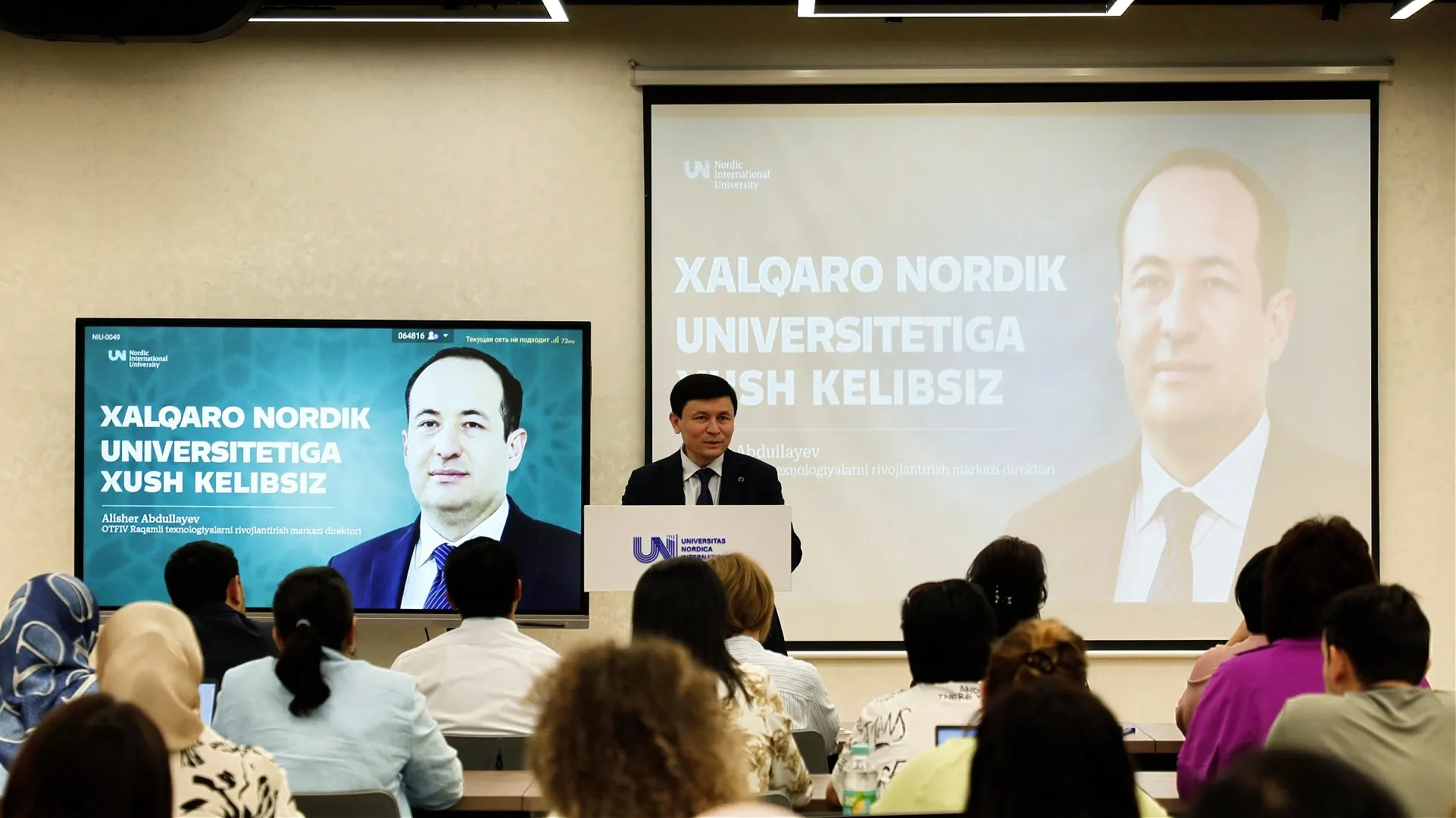
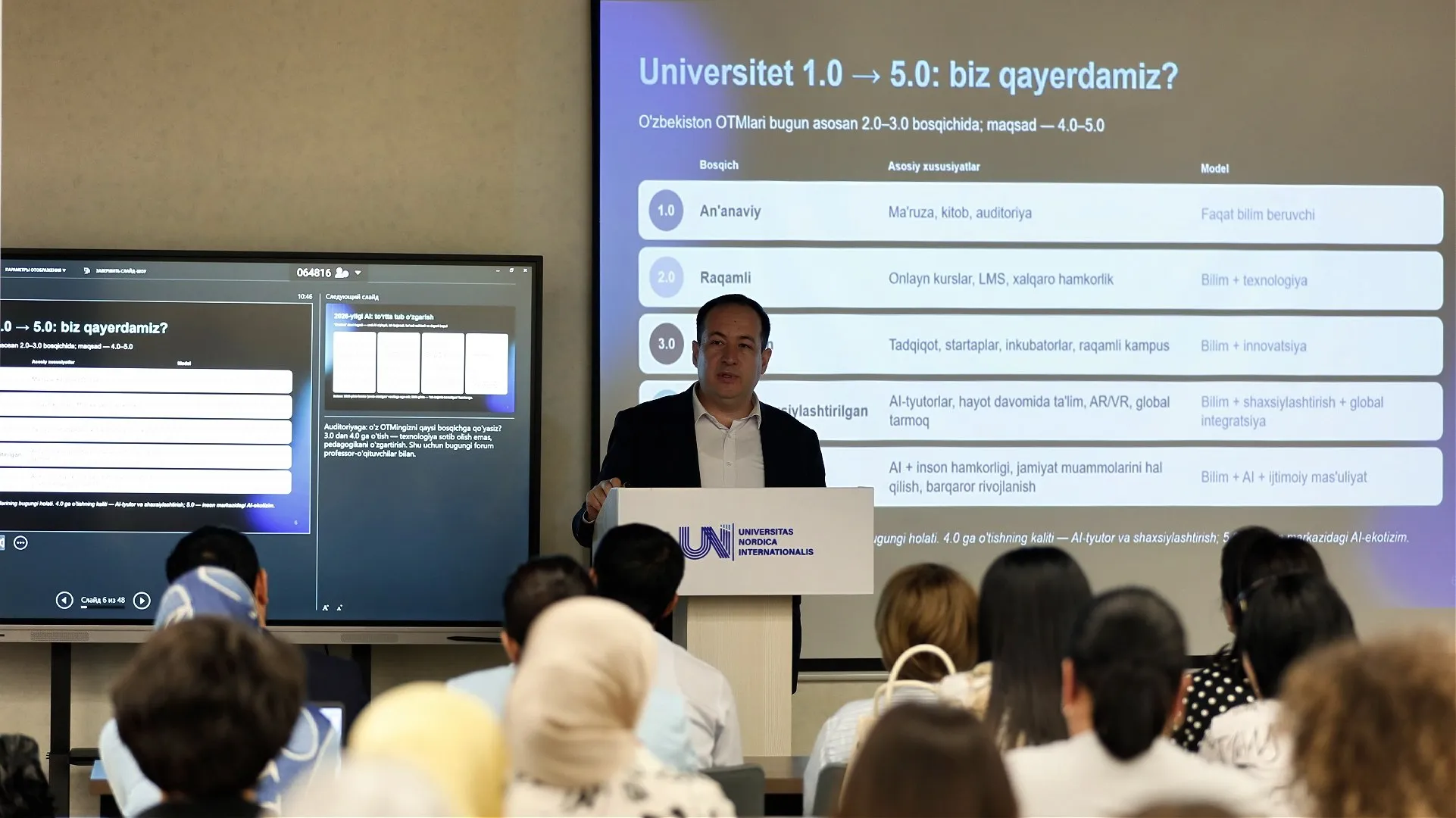
A particularly strong interest was generated by the insightful presentation of Alisher Abdullaev, Director of the Center for Digital Education and Artificial Intelligence Development under the Ministry of Higher Education, Science and Innovation. His presentation examined artificial intelligence as a transformative force that is prompting higher education institutions to rethink educational content, pedagogical approaches, assessment frameworks, and the culture of academic research.
It was emphasized that AI should be viewed as a tool that augments the intellectual capabilities of educators, rather than replaces them. The proposed augmentation model of human–AI interaction enables AI to save valuable time in preparing lecture materials, learning resources, assessments, analytical outputs, translations, research-related tasks, and administrative work. However, final decisions, pedagogical responsibility, critical thinking, and academic integrity must remain firmly in human hands.
This approach also transforms the role of the university educator: from being the sole source of knowledge to becoming an architect of the learning process, mentor, facilitator of critical thinking, and responsible evaluator of AI-generated outputs.
Key Opportunities of AI in Higher Education
As highlighted during the presentation, the most significant opportunities offered by AI in higher education include:
➖ Personalized and adaptive learning — tailoring educational approaches to students’ individual needs, levels of preparedness, and learning pace;
➖ Optimizing faculty time — accelerating the preparation of learning materials, assignments, assessments, and preliminary analytical work;
➖ Supporting academic research — analyzing scholarly literature, generating research ideas, improving the IMRAD structure of academic papers, and identifying grant opportunities;
➖ Enhancing educational quality analysis — using large volumes of data to identify patterns in student performance and broader trends within the educational process;
➖ Strengthening creativity and innovation — developing simulations, interactive assignments, visual resources, and innovative learning formats;
➖ Facilitating academic and scholarly communication — supporting translation, academic editing, and preparation of manuscripts for international publications;
➖ Developing digital competencies — preparing students not merely to obtain ready-made answers from AI, but to interact effectively with AI systems and critically evaluate their outputs.
“Artificial intelligence will not replace university educators. However, educators who know how to use AI effectively will gain a competitive advantage.”
In the new era, AI competency is becoming an increasingly important dimension of professional competitiveness for university educators.
Students are not paying for the time of an LLM; they are paying for the time, expertise, and mentorship of their educator.
The value created for students lies not in a ready-made AI response, but in the experience, mentorship, and individualized guidance provided by the educator.
What matters is not who uses AI the most, but who uses it most effectively.
The priority is not the volume of technology use, but its purposefulness, quality, and impact.
AI can serve as a source of knowledge and a powerful learning tool. But only humans can determine what should be learned, why it matters, and how it should be learned.
Technology, therefore, should not become the center of education. The human being, human thought, and human responsibility must remain at its core.
“Two Tracks” — A New Philosophy of Assessment
Another important issue addressed during the presentation was the need to rethink assessment in the age of artificial intelligence. The “Two-Track” model was presented as a practical approach to this challenge.
Under the Open Track, the use of AI is permitted. For assignments such as projects, analytical papers, portfolios, and research proposals, students are expected to demonstrate not only the final product, but also how they interacted with AI, what decisions they made, and how they verified the accuracy and quality of the resulting work.
Under the Closed Track, students’ knowledge and independent thinking are assessed directly through classroom-based written or practical tasks, oral defenses, and short 10–15-minute interviews or examinations.
The fundamental principle of this approach is not to prohibit AI, but to cultivate a responsible and meaningful culture of AI use.
AI: Opportunity Accompanied by Responsibility
The seminar also placed particular emphasis on AI ethics. Academic integrity, personal data protection and privacy, transparent disclosure of AI use, respect for copyright, and human accountability for the final outcome were identified as key principles.
In this context, the “AI → Expert → Student” model represents an important conceptual approach. AI provides information and expands possibilities; the expert, in turn, verifies, interprets, and directs these capabilities toward clearly defined educational objectives.
Alisher Abdullaev also presented recent updates and new functionalities of the HEMIS platform, highlighting opportunities for more effective use of its capabilities.
These developments are important not only for systematizing large volumes of higher education data and accelerating management decisions, but also for laying the foundation for high-quality data environments that can support future AI applications.
Alongside AI, the seminar addressed the broader digital infrastructure of higher education.
Hasan Topilov, Head of the IT Department at Nordic, conducted a practical session on using new digital platforms to prepare syllabi and manage and monitor faculty KPI indicators.
Participants were also introduced to the capabilities of a new electronic platform designed to facilitate the formation of teaching workloads and the allocation of teaching hours.
Special attention was given to “Munozara” — an AI-powered platform for analyzing academic research. The session demonstrated how the platform can support PhD and DSc researchers by analyzing their scholarly work, generating potential questions and critical observations, and helping them prepare more effectively for dissertation defenses.
From Digital Infrastructure to a New Academic Culture
As emphasized throughout the seminar-training, the digital transformation of higher education cannot be reduced to the introduction of new platforms and technologies.
Its next stage is the development of a new academic culture in which data, digital technologies, and artificial intelligence are used thoughtfully, responsibly, and effectively to achieve educational and research objectives.
Today, one of the university’s most important competitive advantages lies in its ability to use AI intelligently and purposefully to enhance educational quality, strengthen research outcomes, and develop human capital.
At Nordic, these essential competencies were further strengthened ahead of the new academic year, laying the groundwork for a more innovative, technology-enabled, and human-centered model of higher education.


Follow Nordic on social media