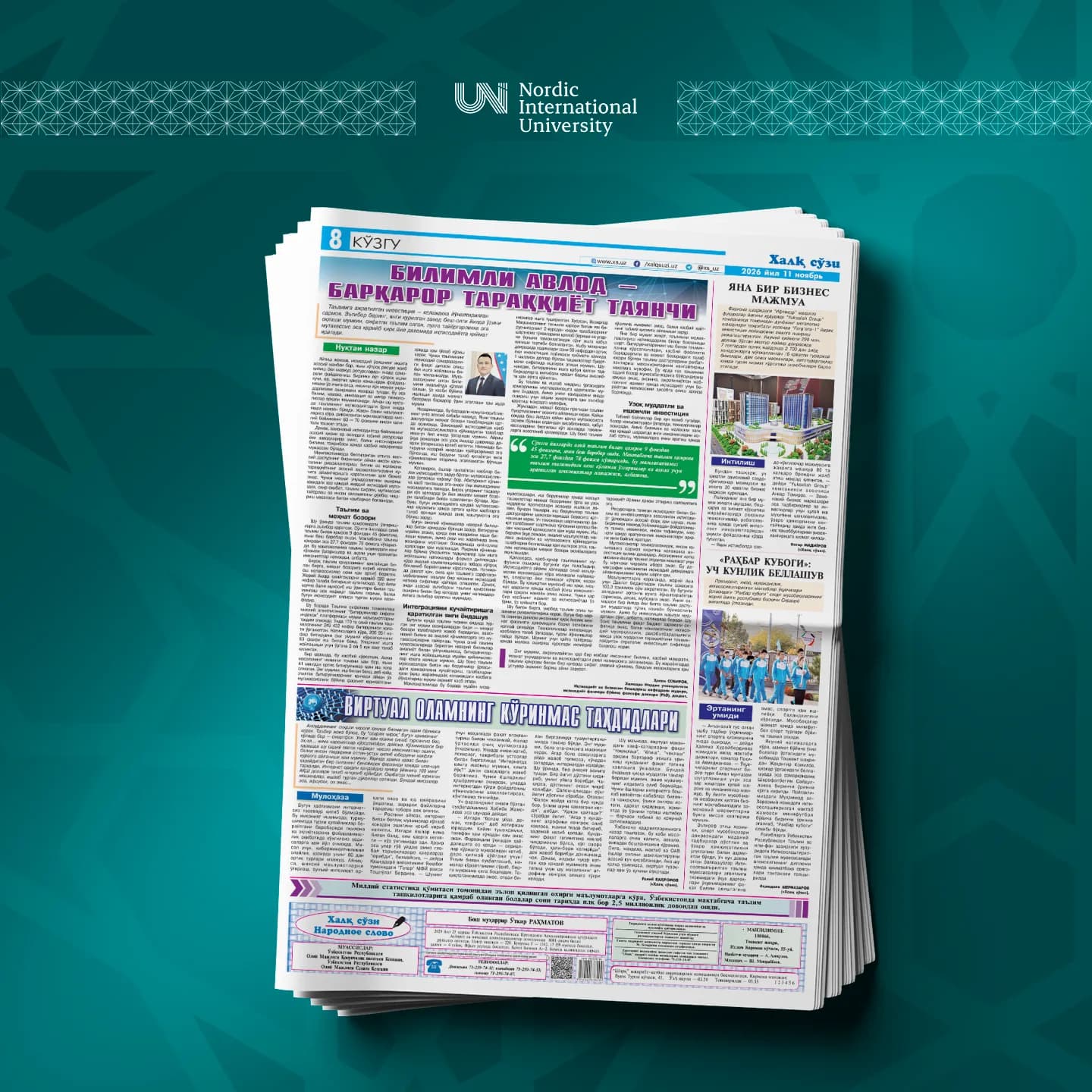
The article entitled “An Educated Generation — The Foundation of Sustainable Development,” published in today’s issue of the Xalq So‘zi newspaper, explores this very question from both economic and social perspectives.
The author, Hasan Sabirov, PhD in Economics and Head of the Department of Economics and Business Management at Nordic University, presents education not merely as a social sector or an item of public expenditure, but as a strategic investment that determines a country's long-term economic potential.
One of the central themes of the article is the interdependence between the quality of education and the labour market. Today, employers seek professionals who possess not only theoretical knowledge but also practical skills, professional competencies, adaptability, and the ability to work with modern technologies.
As the author emphasises, educational programmes must be aligned with the evolving needs of the economy, while universities need to strengthen their partnerships with employers. Students' practical experience, internships, professional preparation, and graduates' employment outcomes are increasingly becoming key indicators of educational effectiveness.
The figures also illustrate the scale of progress in the education sector:
➖ The higher education enrolment rate has increased from 9% to 45% in recent years.
➖ Preschool education coverage has risen from 27.7% to 78%.
➖ A total of UZS 100.3 trillion has been allocated to the education sector this year.
These figures reflect the expanding accessibility of education. However, the article highlights that expanding access must go hand in hand with improving educational quality, strengthening graduates' competitiveness, and ensuring tangible returns on investment.
From this perspective, the article also identifies three key priorities facing modern universities.
📖 Read the full article in the 11 November issue of the Xalq So‘zi newspaper.



Follow Nordic on social media