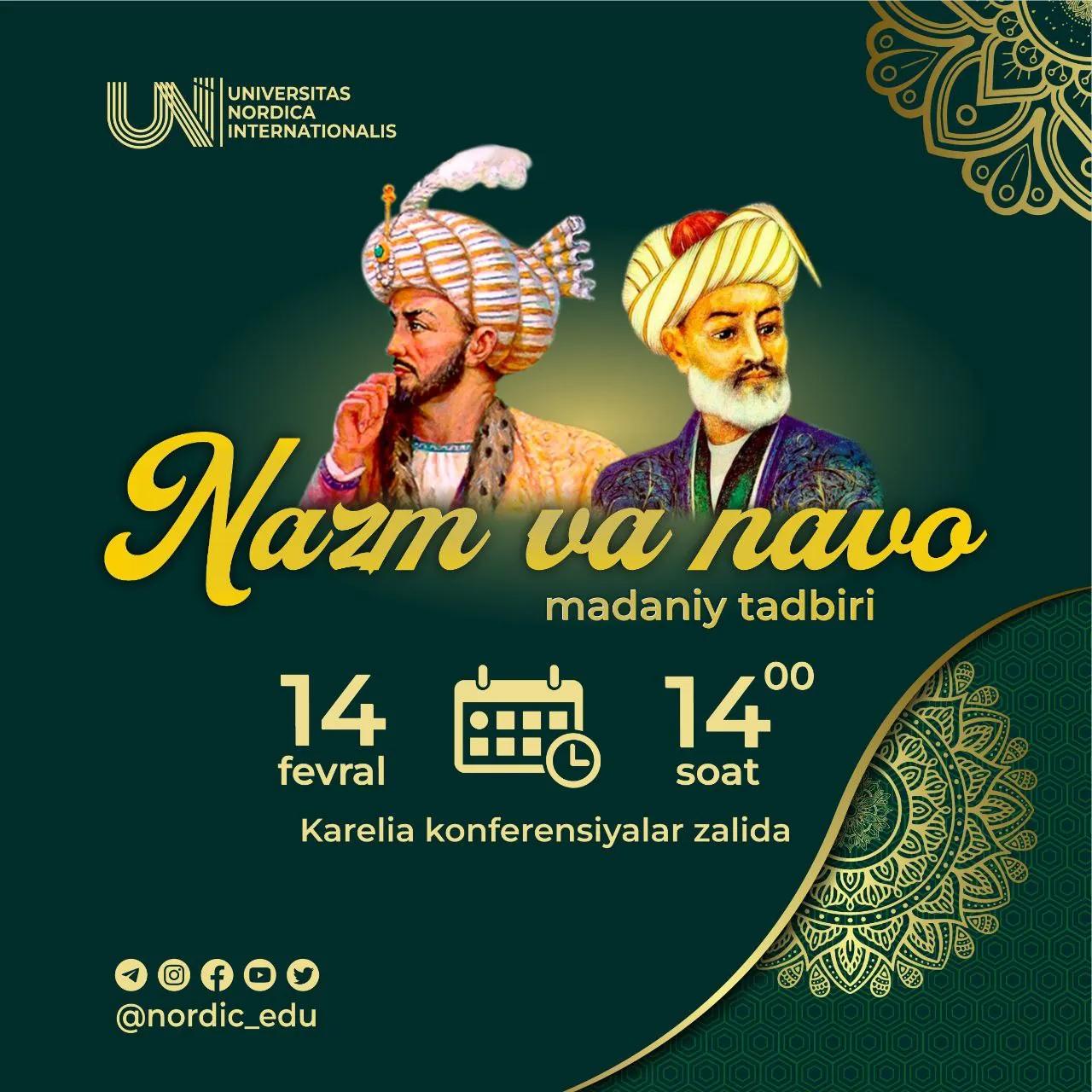
We invite all teachers and students to the "Nazm va Navo" evening!

February 13 , 2023
1138
NIU will host the "Nazm va Navo" evening dedicated to Navoiy and Babur.
📚 A literary and musical evening dedicated to the 582nd anniversary of Alisher Navoiy and the 540th anniversary of Zahiriddin Muhammad Babur.
📅 Date: February 14, 14:00
📍 Venue: Karelia Conference Hall
🎭 Special guests of the event:
🫥 Munojat Yo‘lchiyeva – Professor of the "Music Education" Department, Hero of Uzbekistan
🫥 Navfalbek Boltayev – Uzbek TV channel announcer
🫥 And other distinguished guests
🏆 The event will also feature:
🎁 Award ceremony for the winners of the video contest and monologue challenge
🎼 Poetry and musical performances
💥 Join us for the "Nazm va Navo" evening and immerse yourself in the festive spirit!
Latest news

TasIMO Problems Gain Recognition from the International Mathematical Community!
This stands as a significant indication that TasIMO problems are being acknowledged and appreciated by international experts, olympiad participants, and professional mathematicians alike.
📣 For reference,today AoPS is regarded as a leading scientific and educational platform used by millions of gifted students, award winners, and mathematics olympiad coaches around the world.
The platform is widely recognized for its intellectually challenging problems that foster deep analytical thinking, unconventional approaches, and advanced mathematical reasoning.
📌 The inclusion of TasIMO problems on this platform demonstrates that the Olympiad’s tasks meet international standards, while also confirming the global recognition of its scientific and methodological quality. Moreover, it reflects the growing interest in TasIMO as an emerging mathematics education brand representing Uzbekistan and the wider region.
Today, TasIMO is more than just an olympiad — it is a new mathematical movement showcasing the intellectual potential of young minds to the world.

A major IPO on the London Stock Exchange — yet another vivid confirmation of the irreversible reforms in New Uzbekistan
Using the example of a major IPO (Initial Public Offering) conducted on the London Stock Exchange, the author demonstrates how the country is taking confident and strategic steps toward integration into the global capital market. The article supports its arguments with factual evidence, expert opinions, and reactions from international investors.
One of the most compelling aspects of the publication is its interpretation of the IPO as a significant turning point in Uzbekistan’s path toward openness, investment attractiveness, and economic modernization. In particular, the interest shown by global investment giants such as BlackRock and Franklin Templeton is presented as a powerful indicator of growing international confidence in the Uzbek economy.
The author also explains the IPO mechanism in a clear and accessible manner, enabling ordinary readers to better understand the interconnected nature of the stock market, investor confidence, international ratings, and capital flows. The listing on the London Stock Exchange is described as a form of an “international certificate of trust” for Uzbekistan’s economy.
What advantages does an IPO bring?
Why is the London Stock Exchange so important?
How can it influence society and economic development?
Readers will find comprehensive and well-grounded answers to these and many other important questions throughout the article.
📰 To gain a deeper understanding of the essence of New Uzbekistan’s economic reforms, explore the 25 May issue of “Xalq so‘zi.”

Estonian Experience for Nordic: New Opportunities in Tallinn
During the visit, delegation members met with representatives of the Tallinn City Government to discuss the implementation of modern governance mechanisms in education, the enhancement of educational quality through digital platforms, and the expansion of international collaboration.
The delegation also visited the e-Estonia Briefing Centre, where they explored Estonia’s advanced digital governance model. Presentations on the integration of artificial intelligence, electronic services, and contemporary EdTech solutions into the educational process attracted significant interest.
In addition, negotiations held at the Estonian Association of Information Technology and Telecommunications focused on prospective cooperation in the fields of IT, telecommunications, and innovative projects.
One of the most significant meetings of the visit took place at Tallinn University of Technology (TalTech), where presentations were delivered on artificial intelligence, e-governance, and the concept of a digital state.
The parties reached preliminary agreements on strengthening cooperation through student exchange programmes, joint scientific research initiatives, and the signing of a memorandum of understanding.
Furthermore, the delegation actively participated in the international “EdTech Testbeds” conference, exchanging expertise on modern educational technologies with specialists from Finland, Germany, Estonia, and other countries.
This working visit resulted in important agreements that will contribute to the consistent implementation of the International Nordic University’s goals in international integration, innovative education, and digital development.

Uzbekistan’s Intellectual Potential Showcased at the Final Stage of “TasIMO–2026”
The project was initiated by the International Nordic University and the IDC Educational Center in cooperation with the Ministry of Higher Education, Science and Innovations of the Republic of Uzbekistan, the Ministry of Preschool and School Education, UNICEF, the United States’ Rowan University, and Finland’s Karelia University of Applied Sciences.
This prestigious initiative served not only as an intellectual competition among gifted students, but also as a practical reflection of Uzbekistan’s policy of openness in international education, academic integration, and intellectual diplomacy.
The final stage brought together 150 talented young mathematicians selected from all regions of Uzbekistan, alongside more than 200 participants from numerous countries, including the United States, Germany, the United Kingdom, Russia, Kazakhstan, Pakistan, and Bulgaria. As a result, the Olympiad evolved into an influential international platform fostering scientific and intellectual collaboration among young people from different nations.
The general sponsor of the event was Asia Alliance Bank, while media partners included UzReport TV, as well as the newspapers “Xalq so‘zi” and “Narodnoye slovo.”
The Olympiad programme was designed as a three-day large-scale intellectual festival aimed at identifying and supporting gifted youth, preparing them for international academic competitions, and developing their logical thinking, strategic decision-making, and analytical reasoning skills.
The final stage officially commenced on 19 May, when participants were assigned to examination halls according to their grade levels and the competition rounds began. Students in grades 3–9 completed a 90-minute contest, while participants in grades 10–11 undertook a demanding four-and-a-half-hour mathematical challenge. The tasks were specifically designed to assess logical reasoning, algorithmic thinking, and analytical competence.
Fairness, transparency, and impartiality were established as the core principles of the Olympiad process. More than 25 distinguished jury members made significant contributions to ensuring the high standard of the competition. In particular, international experts such as Alexander Antropov, Patrik Bak, Ivan Chan, David Hruška, Vlad Matei, and Marek Murin, together with many other dedicated professionals, worked tirelessly throughout the assessment and appeals procedures with exceptional professionalism and objectivity. The appeals committee remained active until late evening hours, further strengthening trust among participants, teachers, and parents.
One of the defining features of “TasIMO–2026” was that it provided participants not only with an academic competition environment, but also with opportunities for social and personal development. Within the framework of the Olympiad, participants engaged in problem-analysis sessions, appeal discussions, intellectual exchanges, and interactive workshops that encouraged independent thinking, critical analysis, and self-improvement.
In addition, sports competitions, the intellectual game “Zakovat,” concerts and entertainment programmes, kite flying, tug-of-war contests, team-based activities, nature excursions, a “Pizza Party,” and interactive events inspired by the format of the “Squid Game” contributed to the development of leadership, teamwork, and communication skills among participants.
In today’s modern educational landscape, high academic achievement alone is no longer considered sufficient; emotional intelligence, social adaptability, and global thinking have become equally important indicators of success.
At the final stage of the Olympiad, Uzbekistan’s young mathematics talents achieved remarkable results, securing 9 out of 12 gold medals, 10 out of 15 silver medals, 12 out of 18 bronze medals, and 24 out of 75 “Honourable Mention” certificates. These outstanding achievements clearly demonstrate the strong intellectual potential and academic excellence of the country’s younger generation.